
Unitree’s Real-Life Transformer Signals the Next Era of Humanoid Robotics
A Nine-Foot Robot, a Human Cockpit, and the Future of Physical AI
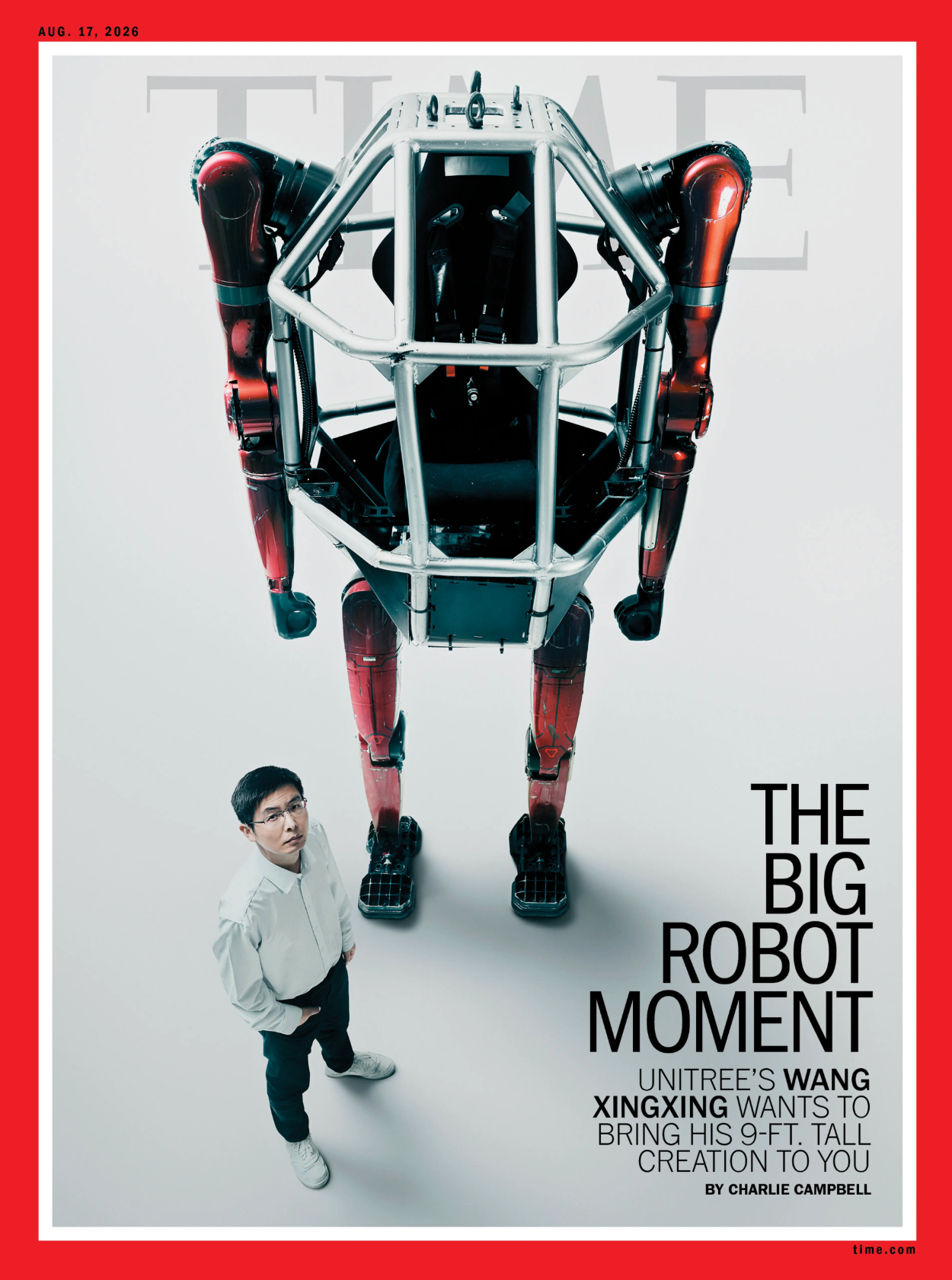
A nine-foot-tall robot capable of carrying a human, walking on two or four legs, and delivering punches powerful enough to knock down walls sounds like something from a science-fiction movie. But Unitree’s GD01 is real. The massive robot was recently featured by TIME as part of an exclusive look inside the rapidly advancing humanoid robotics industry. Built by Chinese robotics company Unitree, the GD01 stands approximately nine feet tall, weighs half a ton, and includes a cockpit that can transport a human pilot. Unitree describes it as the world’s first mass-produced, transformable mecha robot.
The Closest Thing Yet to a Real-Life Transformer
Unitree founder and CEO Wang Xingxing reportedly drew inspiration from both combat sports and the large piloted robots seen in the movie Avatar. The result is a machine that looks unlike almost anything currently available in commercial robotics. The GD01 is built with titanium-alloy limbs, carbon-fiber protection, heavy-duty mechanical joints, and powerful red legs designed to support its enormous frame. It can move on two legs or transition to four, creating a machine that feels closer to a real-life Transformer than a traditional industrial robot. The GD01 may be Unitree’s most dramatic creation, but it is not necessarily the company’s most important. Smaller humanoid robots, including Unitree’s G1, may ultimately have a much greater impact on the global economy.
Humanoid Robots Are Moving Beyond Science Fiction
Unitree began with quadrupedal robot dogs before expanding into humanoid machines and human mobility systems.
The company shipped more than 5,500 robots in 2025, accounting for more than a quarter of the emerging global humanoid market. Its robots are currently being used by universities, developers, research institutions, commercial venues, and a growing number of industrial customers.
Unitree has also worked to make its technology more affordable. The company reduced the price of its G1 humanoid from approximately $16,000 to $13,500, while its smaller R1 model reportedly sells for less than $5,000.
This rapid decline in cost could help humanoid robots follow a path similar to personal computers, smartphones, drones, and electric vehicles. Early models may be expensive and limited, but increasing production, better software, and growing competition could eventually bring the technology into factories, businesses, and homes.
How Large Could the Humanoid Market Become?
The potential scale of the humanoid robotics industry is enormous.
Morgan Stanley predicts that as many as 13 million humanoid robots could be operating by 2035. By 2050, that number could potentially reach one billion, creating an industry valued at approximately $5 trillion. These machines could eventually perform tasks in manufacturing, warehouses, health care, agriculture, construction, maintenance, and household assistance. They may take on jobs that are repetitive, physically demanding, dangerous, or difficult for employers to fill. Humanoids could work around the clock, move through environments designed for people, and use many of the same tools humans already use. However, the technology is not fully ready for mass adoption. Today’s humanoids can perform impressive demonstrations, but many still struggle when their surroundings change. A robot may successfully complete a task in one controlled environment and then fail when an object is moved, the lighting changes, or the surface beneath it is different. Closing this gap between scripted demonstrations and true real-world intelligence is one of the industry’s greatest challenges.
The Race to Build the Robot Brain
Hardware is improving quickly, but the most important competition may be happening inside the robot. Humanoid companies are working to develop vision-language-action models that allow robots to understand verbal instructions, analyze their surroundings, and complete unfamiliar physical tasks. The goal is to create a robot that does not need every movement programmed in advance. Instead of receiving detailed instructions for how to grab an object, walk across a room, and place it on a shelf, a future humanoid could simply be told, “Put this away.” Wang believes the industry could be anywhere from two to 10 years away from its “ChatGPT moment”—an inflection point when humanoid robots become capable enough to begin entering commercial environments at a much larger scale.
A Global Competition Is Already Underway
Unitree is not alone. Tesla is developing its Optimus humanoid robot. Figure has deployed robots in automotive manufacturing environments. Agility Robotics has secured commercial deployments with major companies, and technology leaders including NVIDIA and Google DeepMind are developing the artificial intelligence systems needed to power physical machines. The race is particularly intense between the United States and China. China has invested heavily in artificial intelligence, robotics, manufacturing capacity, and supply chains. More than 140 Chinese companies are reportedly developing humanoid robots, while American companies continue to push forward with their own models, chips, software, and commercial deployments.The winner may not simply be the company with the strongest robot.
It could be the company that collects the most real-world data, develops the most capable artificial intelligence, lowers production costs, and scales manufacturing faster than its competitors.
Why Are Watching Humanoid Robotics?
The GD01 is visually impressive, but its larger significance is what it represents. Humanoid robots are no longer confined to movies, laboratories, or theoretical demonstrations. Companies are building them, selling them, testing them in factories, and preparing them for broader commercial deployment. The industry remains early, and meaningful challenges involving safety, cybersecurity, cost, battery life, reliability, and artificial intelligence still need to be solved. But nearly every major technological revolution begins before the finished product is ready. The humanoid revolution may not happen overnight, but it is already being built. That is why humanoid robotics remains one of the major investment themes behind Xtreme Humanoid. We believe the companies developing the hardware, software, artificial intelligence, chips, sensors, and infrastructure behind these machines could help shape the next era of technology. The GD01 may look like a real-life Transformer today.
In the future, machines like it may represent something even larger: the beginning of a world where intelligent robots work alongside us.